Arnica – properties and uses. Arnica ointment and arnica oil
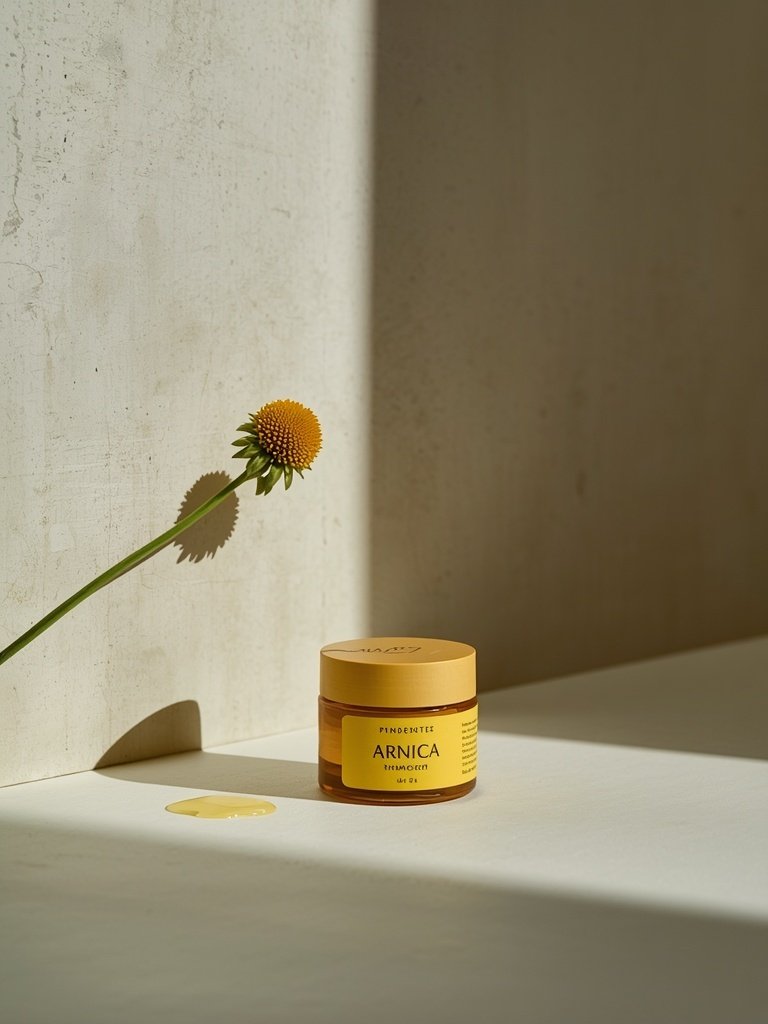
Table of Contents 4
Medical & Editorial Disclaimer (§3 Terms): This article is for informational and educational purposes only, does not constitute medical advice, diagnosis, or treatment, and is used at your own risk. Consult a qualified physician for medical conditions.
The therapeutic attributes of mountain arnica stem from a rich repository of bioactive constituents, including sesquiterpene lactones such as helenalin, volatile oils, flavonoids, saponins, triterpenoids, phytosterols, carotenoids, tannins, and mineral complexes. When applied topically, these compounds exhibit remarkable transdermal bioavailability, penetrating through the stratum corneum deep into the dermis. Once absorbed, they help fortify the structural integrity and flexibility of capillary and lymphatic vessel walls, enhance microcirculatory dynamics, and assist in mitigating inflammatory exudate and soft tissue edema.
In daily wellness routines, individuals can choose between topical arnica ointments and arnica-infused oil, the latter produced by macerating dried flowers in a carrier such as sunflower oil. This viscous, deep orange to brownish extract features a pleasant cinnamon-like aroma and provides beneficial fatty acids, phenolic acids, and flavonoid derivatives like quercetin and kaempferol. Applying these preparations externally offers practical, targeted care to support the resolution of bruises, post-traumatic swelling, and rheumatic discomfort, though topical botanical products should always complement rather than replace professional medical evaluation for acute injuries.
Mountain arnica (Arnica montana L.): A medicinal herb of substantial pharmacological value
Distinctive attributes and therapeutic applications of mountain arnica (*Arnica montana*) in medicine and cosmetology
Topical arnica preparation: properties and therapeutic applications in injury management and rheumatic conditions
Mountain arnica-infused oil: composition, therapeutic properties, and clinical applications
Want to apply these guidelines in your daily diet?
Our smart diet generator creates a tailored meal plan in 3 minutes based on the recommendations in this article.
Tags

mgr Literatura: Senderski Mateusz, Prawie Wszystko O Ziołach I Ziołolecznictwie . Mateusz E. Senderski, 2015. Nartowska Jadwiga, “Arnika- lek z gór i łąk,” Panacea , vol. 3, no. 44, 2013. Mederska Małgorzata., Atlas roślin leczniczych , SB,. Wydawnictwo SBM, 2013. G. Lyss, T. J. Schmidt, I. Merfort, and H. L. Pahl, “Helenalin, an anti-inflammatory sesquiterpene lactone from Arnica, selectively inhibits transcription factor NF-kappaB.,” Biol. Chem. , vol. 378, no. 9, pp. 951–61, Sep. 1997. “Assessment report on Arnica montana L., flos,” Comm. Herb. Med. Prod. , 2013. Stephen Ehrlich, “Arnica,” Univ. Maryl. Med. Cent. , 2015. “Arnika górska / Arnica montana – zastosowanie, działanie i opis – www.doz.pl.” [Online]. Available: https://www.doz.pl/ziola/p5500-Arnika_gorska. [Accessed: 05-Oct-2017]. Kevin Leivers, “Unravelling the confusion around arnica’s herbal and homeopathic uses,” Pharm. J. , vol. 275, 2005. P. May and F. Naturextrakte, “Arnica Flower CO2 -Extract- Approved Efficacy in Topical Treatment,” Cosmet. Sci. Technol. , 2013. M. Ganzera, C. Egger, C. Zidorn, and H. Stuppner, “Quantitative analysis of flavonoids and phenolic acids in Arnica montana L. by micellar electrokinetic capillary chromatography,” Anal. Chim. Acta , vol. 614, no. 2, pp. 196–200, May 2008. K. L. Pumpa, K. E. Fallon, A. Bensoussan, and S. Papalia, “The effects of topical Arnica on performance, pain and muscle damage after intense eccentric exercise,” Eur. J. Sport Sci. , vol. 14, no. 3, pp. 294–300, Apr. 2014.
• 25.09.2026Diets Premium Expert
Diets Premium team expert. Specializes in nutrition plans, strength sports, and training plans.