Pull-ups – technique analysis, grip variations, engaged muscles, and tips for beginners
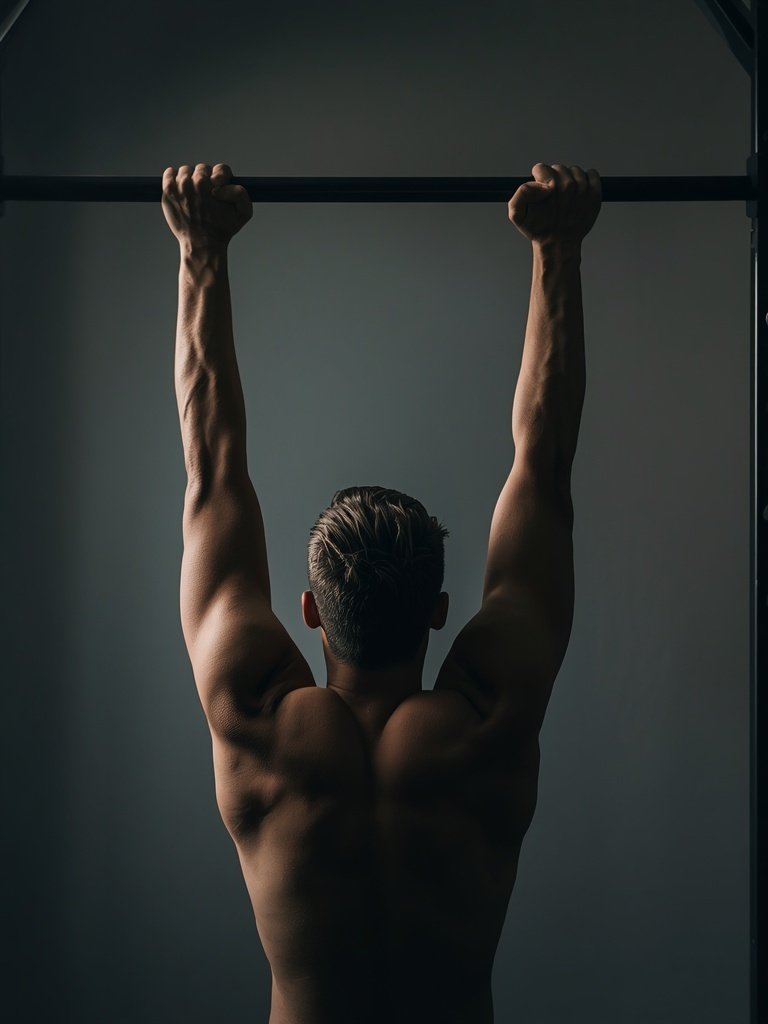

Table of Contents 4
Medical & Editorial Disclaimer (§3 Terms): This article is for informational and educational purposes only, does not constitute medical advice, diagnosis, or treatment, and is used at your own risk. Consult a qualified physician for medical conditions.
From a physiological perspective, pulling movements on a bar recruit an extensive network of posterior and upper-body muscles, including the latissimus dorsi, teres major, rhomboids, middle and lower trapezius, posterior deltoids, deep rotator cuff stabilizers, and elbow flexors, while the anterior core maintains isometric rigidity. Adjusting hand placement alters biomechanical leverage and shifts muscular emphasis. An overhand pronated grip heavily targets the latissimus dorsi and lower trapezius, an underhand supinated grip places the biceps brachii in an advantageous mechanical position, and a neutral parallel grip provides a highly ergonomic pathway that minimizes rotational stress on the shoulders and wrists.
To execute the movement safely in daily training, athletes should initiate every repetition from a full dead hang with active scapular depression and retraction before bending the elbows, maintaining a braced hollow-body core to prevent momentum or swinging. For beginners who are still working toward their first unassisted repetition, structured progression protocols offer a reliable pathway to building foundational strength. Incorporating elastic resistance bands for ascending assistance, focusing on slow and controlled eccentric lowering phases, and practicing inverted rows on a low bar allow the nervous system and musculature to adapt progressively toward full bodyweight mastery.
This article is professional premium content (PRO) provided in its entirety.
The pull-up is an irreplaceable compound upper-body exercise in calisthenics and strength conditioning, serving as the gold standard for relative upper-body strength. This comprehensive biomechanical guide covers proper form execution, distinguishes overhand, underhand, and neutral grips, details prime mover musculature, and outlines a safe step-by-step progression plan for beginners.
Bar pull-ups for beginners: Progression protocols
As is known, the beginnings are always the hardest. Many people do not do pull-ups on the bar to avoid ridicule and malicious jokes from other gym-goers. However, it should be remembered that when we enter a room with hundreds of kilograms stacked up, only our body and its work matter; we train for ourselves, not for others. Nevertheless, we want to start pulling ourselves up correctly at least a few times as soon as possible, so how can we help ourselves at the beginning? There are three basic techniques:
Use of equipment
Pull-ups using machines is one of the exercises I wholeheartedly recommend to people starting their gym journey, unlike other basic movements performed with free weights. Of course, if someone is able to perform several correct repetitions, they can skip this stage, but many people have trouble with this at the beginning of their journey, so it is worth not getting discouraged quickly and using the machine option. There are two basic types of machines that facilitate pull-ups:
pull-up imitation with a pad under our knees, pulling the upper cable pulley in a seated position. In both cases, there is a high possibility of adjusting the load, thus facilitating movement, but the first type of machine occurs much less frequently and we can find it rather in larger gyms than in small neighborhood clubs. Note that when performing lat pulldowns, do not lean your torso excessively backward, as this will engage the latissimus dorsi muscles to a lesser extent. These machines allow you to gain some experience and prepare your muscles for pulling up on a bar, so as soon as we feel strong enough, we should move on to traditional pull-ups. 2. Performing controlled lowering
This exercise is recommended at the beginning of your pull-up journey instead of or after pull-ups, because it allows you to strongly engage the same muscles that work during the dynamic lift of the body to the bar. Before starting the exercise, we need to find a stable bench or something that allows us to stand safely in front of the bar. We grab the bar without lifting our feet off the platform and slowly lower ourselves with our hands, using our feet to help us rise to the starting position, where the arms are bent and the head is above the bar. Remember to descend at a suitably slow pace and maintain constant muscle tension. 3. Use of elastic bands
If we have special bands available, used for stretching or to make strength training more attractive, we can also use them for pull-ups, provided we are already able to perform a small number of repetitions. Such an elastic band passed through the bar on both sides of our arms and attached to our wrists will allow us to increase the number of repetitions and the effort exerted by the back and arm muscles during training.
Correct pull-up execution and movement biomechanics
Flawless pull-up biomechanics requires rigorous adherence to technical cues. The movement must commence with active scapular depression and retraction—pulling the shoulder blades down and back before bending the elbows. Maintain a rigid hollow-body core position with glutes and abdominals engaged, eliminating swinging or kipping momentum. Drive the elbows down toward the hips until the chin clears the bar, pause briefly, and lower under control to a full dead hang with elbows extended.
Grip variations: Overhand, underhand, and neutral grip
Grip variations modulate biomechanical leverage and joint loading:
- Overhand (Pronated) Grip – Pull-Up: Hands slightly wider than shoulders with palms facing away; maximally challenges the latissimus dorsi, teres major, and lower trapezius,
- Underhand (Supinated) Grip – Chin-Up: Palms facing the athlete; places the biceps brachii in optimal mechanical advantage and provides a slightly shorter range of motion,
- Neutral Grip (Hammer Grip): Palms facing each other using parallel bars; offers the most shoulder- and wrist-friendly path, emphasizing the brachioradialis and brachialis muscles.
Training adaptations and muscle recruitment of back and arms
It is a frequently repeated myth that the biceps are heavily engaged during pull-ups. Indeed, this muscle performs work (especially its long head, responsible for raising the arm), but it is a back exercise, regardless of the grip used. Therefore, pull-ups should not be considered an arm workout element; they can, however, be a good warm-up, allowing the initial muscle fatigue to be utilized for heavier work in subsequent sets focused directly on this muscle. Besides the quick increase in strength and number of repetitions, the "side effect" of pull-ups is sculpted back and arm muscles, a correct waist-to-arm ratio, and a V-shaped physique. Over time, as we perform more and more repetitions, we may find that our body mass is not enough for an intense workout. In such cases, we can use elastic bands, this time attached to the floor and, for example, a belt placed on the hips or the calves. We can also use additional weight attached to special vests or belts, or most simply and commonly: attached to a weight belt. However, we must remember that very heavy loads can be detrimental to the lumbar spine, so let's not overdo the weight, focusing instead on correct technique and muscle tension. Finally, I would like to discuss another form of pulling, more often pulling the upper cable pulley, namely with a wide overhand grip in a version behind the neck. Although the muscles involved in the exercise are almost the same as in a classic pull-up, it is a highly unfavorable movement for our shoulder joints, which are, in a very simplified sense, "squeezed" out of the joint socket. In other words, it is not an optimal range of motion for our shoulders, and as we know, these are very sensitive and complex joints. The option is rather discouraged due to the high risk of injury. Pull-ups are a relatively difficult and complex exercise, whose effectiveness is influenced by many factors. Choosing a specific technique, grip, or underhand grip changes the degree of muscle engagement during the movement. Maintaining verticality and the degree of scapular retraction during the movement is also important. Even a slight change in hand placement or how the bar is held can have a fundamental impact on the exercise's effectiveness. For the exercise to be effective, remember that the lowering phase should be longer than the lifting phase. It is during the straightening of the arms at the elbow joints that the muscles perform the most work, and the rate of muscle tissue growth depends on the duration of this phase.
Want to apply these guidelines in your daily diet?
Our smart diet generator creates a tailored meal plan in 3 minutes based on the recommendations in this article.
Tags

mgr Tomasz Jankowski
• 23.10.2026Diets Premium Expert
Diets Premium team expert. Specializes in nutrition plans, strength sports, and training plans.