Do Nordic walking with poles help in fighting overweight?


Table of Contents 6
Medical & Editorial Disclaimer (§3 Terms): This article is for informational and educational purposes only, does not constitute medical advice, diagnosis, or treatment, and is used at your own risk. Consult a qualified physician for medical conditions.
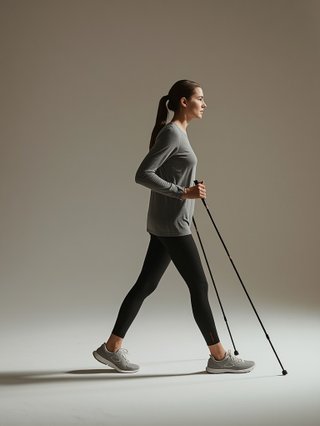
The physiological benefits of Nordic walking depend heavily on proper biomechanical technique, specifically the diagonal synchronization of the upper and lower limbs where the forward stride of one foot pairs with the active propulsion of the opposite arm ending near pelvic level. Engaging the upper body musculature alongside the legs significantly elevates energy expenditure compared to conventional walking and enhances oxygen uptake, which contributes to better tissue oxygenation and improved overall physical conditioning without placing excessive mechanical stress on the joints.
To maximize everyday training benefits, practitioners should equip themselves with appropriate poles, comfortable footwear, and breathable athletic apparel while opting for varied terrains such as forest trails, beaches, or undulating paths that demand greater muscular engagement. However, training should be postponed whenever clinical contraindications arise, including elevated body temperature, acute bacterial or viral infections, anemia, severe physical exhaustion, recent fractures or dislocations, and degenerative musculoskeletal conditions accompanied by intense pain during movement.
Nordic Walking - the concept behind it
The right technique
Ideal location for training
Nordic Walking and the Decrease of Fat Tissue
Nordic walking - instances of non-recommendation
Summary of actions resulting in weight loss through nordic walking
Want to apply these guidelines in your daily diet?
Our smart diet generator creates a tailored meal plan in 3 minutes based on the recommendations in this article.

Pintar J. et al., The influence of fitness and body weight on preferred exercise intensity, „Medicine & Science in Sports & Exercise” 2006, 38(5), 981–988. Porcari J.P. et al., The physiological responses to walking with and without Power Poles on treadmill exercise, „Research Quarterly for Exercise and Sport” 1997, 68(2), 161–166. Takeshima N. et al., Effects of nordic walking compared to conventional walking and band-based resistance exercise on fitness in older adults, „Journal of Sports Science & Medicine” 2013, 12(3), 422. Wilk M. et al., Ocena niektórych fizjologicznych efektów zastosowania Nordic Walking jako uzupełniającego elementu ćwiczeń fizycznych w drugim etapie rehabilitacji po zawale serca, „Rehabilitacja Medyczna” 2005, 9(2), 33–38.
• 22.03.2026Diets Premium Expert
Diets Premium team expert. Specializes in nutrition plans, strength sports, and training plans.