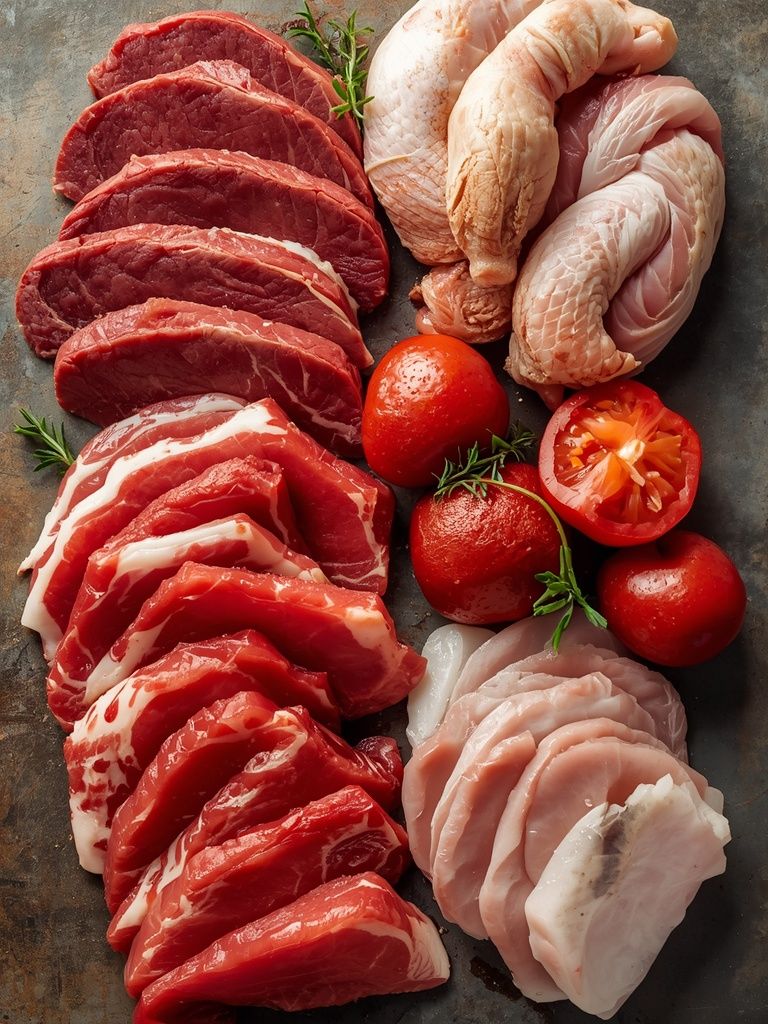
Sliced (from beef, veal, pork, poultry), pan-fried (without added fat and salt)
g
No Added Fat
Pan-Fried
Poultry
Sautéed
Fried
150 KCAL
KCAL / 100g
28.9g
Protein
3.8g
Fat
0.1g
Carbohydrates
No Added Fat
Pan-Fried
Poultry
Sautéed
Fried
Sliced (from beef, veal, pork, poultry), pan-fried (without added fat and salt)
150
KCAL / 100g
28.9g
Protein
3.8g
Fat
0.1g
Carbohydrates
Nutrients
Nutrients
| Name | / 100g |
|---|---|
| Ash | 0.8 g |
| Boron | 0.01 mg |
| Calcium | 8.6 mg |
| Carbohydrate | 0.1 g |
| Carotene Beta | 3 mg |
| Chloride | 83 mg |
| Chlorine | 83 mg |
| Cholesterol | 81 mg |
| Chromium | 10 µg |
| Complete Protein | 28.9 g |
| Copper | 0.08 mg |
| Cysteine | 0.3 g |
| Fat | 3.8 g |
| Fatty monounsaturated | 1.5 g |
| Fatty polyunsaturated | 0.5 g |
| Fatty saturated | 1.2 g |
| Fatty trans | 0.1 g |
| Fiber | 1 g |
| Glutamine | 4.8 g |
| Iodine | 1.9 µg |
| Iron | 1 mg |
| Lutein + zeaxanthin | 10 mg |
| Lysine | 2.5 g |
| Magnesium | 26 mg |
| Manganese | 0.02 mg |
| Methionine | 0.7 g |
| Molybdenum | 10 µg |
| Natron | 62 g |
| Nickel | 0 mg |
| Omega 3 | 0.05 g |
| Omega 6 | 0.45 g |
| Phosphorus | 230 mg |
| Potassium | 350 mg |
| Protein | 28.9 g |
| Protein Animal | 28.9 g |
| Retinol | 4 µg |
| Salt | 0.2 g |
| Selenium | 15 µg |
| Sodium | 78.8 mg |
| Sugar | 1 g |
| Sulfur | 220 mg |
| Taurine | 30 mg |
| Vitamin A | 5 µg |
| Vitamin ARE | 5 µg |
| Vitamin B1 (Thiamin) | 0.33 mg |
| Vitamin B12 (Cobalamin) | 0.84 µg |
| Vitamin B2 (Riboflavin) | 0.18 mg |
| Vitamin B3 (Niacin) | 6.75 mg |
| Vitamin B4 (Choline) | 80 mg |
| Vitamin B5 (Pantothenic acid) | 0.94 mg |
| Vitamin B6 (Pyridoxine) | 0.49 mg |
| Vitamin B9 (Folate) | 4.9 µg |
| Vitamin C (Ascorbic acid) | 1 mg |
| Vitamin D | 0.7 µg |
| Vitamin E | 0.3 mg |
| Vitamin K | 370 µg |
| Water | 67.2 g |
| Zinc | 3 mg |